
To maintain a healthy democracy, the government of Sri Lanka is structured into three main organs: the Legislature, the Executive, and the Judiciary.
This system, known as the Separation of Powers, is designed to prevent the concentration of authority in a single entity, ensuring accountability, fairness, and good governance across the nation.
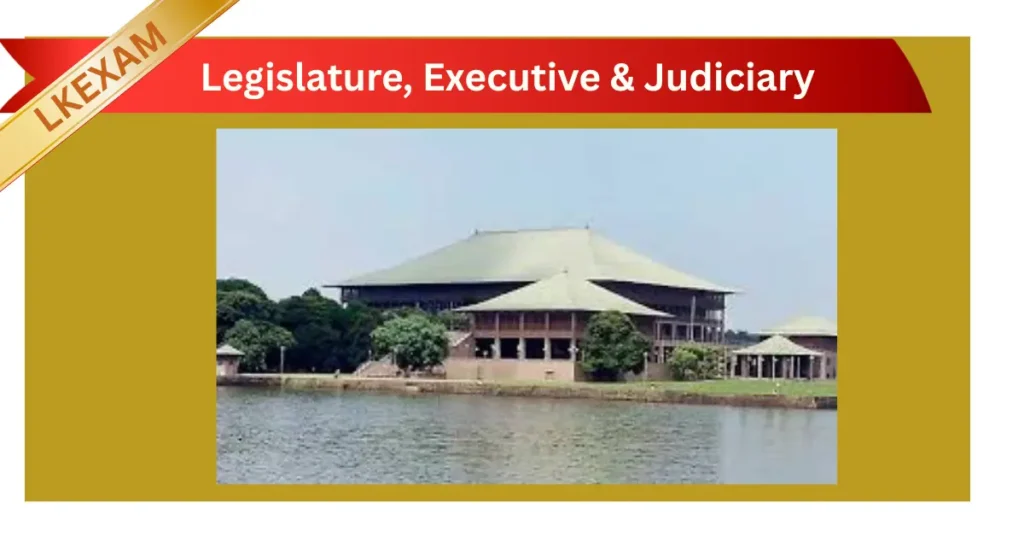
1. The Legislature: The Law-Making Body
The Legislature is the primary organ responsible for drafting and enacting laws. In Sri Lanka, this power is held by Parliament, which serves as the supreme representative body of the people.
- Composition: It consists of Members of Parliament (MPs) who are chosen through democratic elections.
- Primary Duty: Beyond making laws, Parliament also maintains control over public finance and national budgets.
2. The Executive: Implementation and Enforcement
The Executive branch ensures that the laws passed by the Legislature are implemented and enforced effectively.
- Leadership: This branch is led by the President of Sri Lanka, who is directly elected by the citizens as the Head of State and Government.
- Structure: Executive power is exercised by the President, the Cabinet of Ministers, and various government departments or institutions.
3. The Judiciary: Interpretation and Justice
The Judiciary serves as the independent guardian of the law. Its primary role is to interpret legislation and deliver justice to ensure the rule of law is upheld.
- Hierarchy of Courts: Judicial power is exercised through a system of courts, with the Supreme Court at the apex, followed by the Court of Appeal and various lower courts.
- Independence: The judiciary functions autonomously to remain free from political influence, ensuring every citizen receives a fair trial and that fundamental rights are protected.
Legislature, Executive & Judiciary – Sri Lanka Governance Quiz
Test your knowledge of the Sri Lankan democratic system by choosing the correct answer for each question below.
Test Your Knowledge
1. How many main organs of government exist in Sri Lanka?
A. Two B. Three C. Four D. Five
Answer: B
2. Which body is responsible for making laws in Sri Lanka?
A. Executive B. Judiciary C. Parliament D. Police
Answer: C
3. Legislative power is primarily exercised by the:
A. President B. Parliament C. Courts D. Cabinet
Answer: B
4. Who serves as the head of the Executive branch?
A. Prime Minister B. Speaker of the House C. President
D. Chief Justice
Answer: C
5. Executive power is mainly carried out by:
A. Courts B. Parliament C. President and Cabinet
D. Election Commission
Answer: C
6. Which organ is responsible for interpreting laws?
A. Legislature B. Executive C. Judiciary D. Police
Answer: C
7. Which court holds the highest authority in Sri Lanka?
A. High Court B. District Court C. Supreme Court D. Court of Appeal
Answer: C
8. Who is recognized as the head of the Judiciary?
A. Attorney General B. Chief Justice C. President D. Speaker
Answer: B
9. How are Members of Parliament typically chosen? A. Appointed by the Cabinet
B. Elected by the citizens
C. Selected by courts
D. Chosen by the President
Answer: B
10. Which organ is tasked with implementing laws?
A. Legislature B. Executive C. Judiciary D. Election Commission
Answer: B
11. What does “Judicial Independence” imply? A. Courts are controlled by Parliament B. Courts are free from outside influence C. Courts create new legislation D. Courts enforce criminal laws directly Answer: B
12. Which organ ensures the consistent rule of law? A. Legislature B. Executive C. Judiciary D. Police
Answer: C
13. Who is the official that presides over Parliament? A. President B. Prime Minister C. Speaker D. Chief Justice
Answer: C
14. Which organ is responsible for controlling public administration?
A. Judiciary B. Executive C. Legislature D. Courts
Answer: B
15. The “Separation of Powers” is primarily intended to:
A. Increase the risk of dictatorship
B. Prevent the misuse of power
C. Abolish periodic elections
D. Remove the court system
Answer: B
16. Which government organ must approve the national budget?
A. Executive B. Judiciary C. Parliament D. Election Commission
Answer: C
17. In Sri Lanka, who is responsible for appointing judges?
A. Parliament B. President C. Prime Minister
D. Speaker
Answer: B
18. Which organ has the authority to question the actions of the Executive?
A. Judiciary B. Parliament C. Police D. Army
Answer: B
19. Which branch is the primary protector of fundamental rights?
A. Legislature B. Executive C. Judiciary D. Cabinet
Answer: C
20. Why is the coexistence of these three organs vital?
A. To share power fairly and maintain democracy
B. To weaken the democratic process
C. To remove the need for elections
D. To limit the rights of individuals
Answer: A
See more – Franchise (Right to Vote)