

Why Balangoda Man Is Important in Sri Lankan History
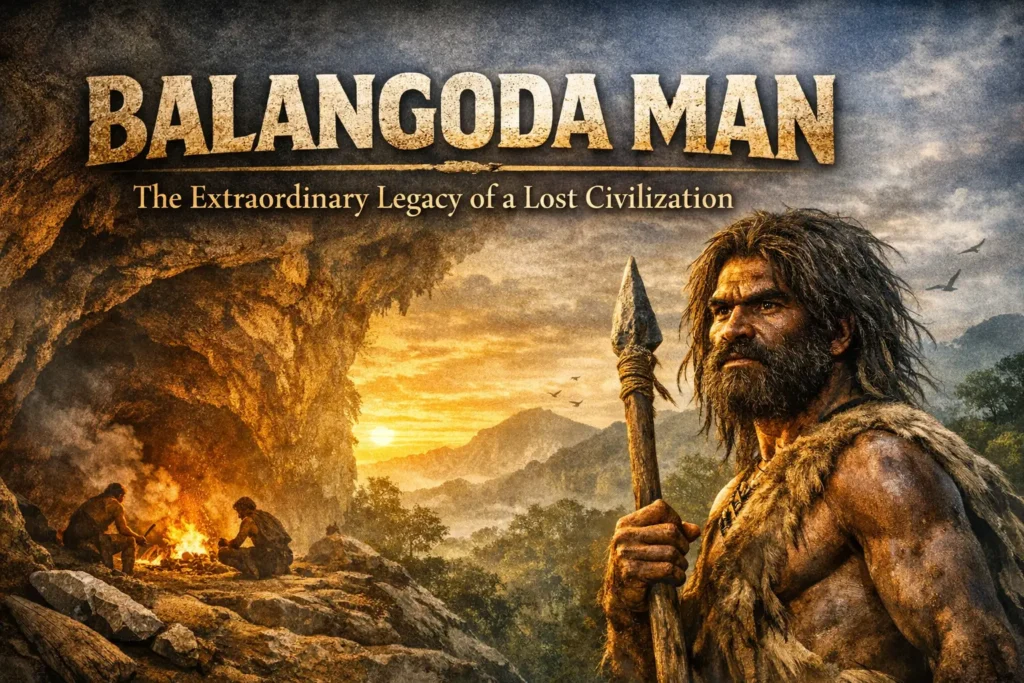
Who is the Balangoda Man?
This question takes us deep into the prehistoric past of Sri Lanka, long before written history began.
The Balangoda Man refers to the earliest known inhabitants of Sri Lanka, believed to have lived more than 30,000 years ago during the Late Pleistocene era.
Discovered through skeletal remains and archaeological findings in caves such as Fa-Hien Lena and Batadomba Lena, the Balangoda Man represents one of South Asia’s most significant prehistoric human groups.
The term “Balangoda Man” does not describe a single individual, but rather a group of early hunter-gatherers who once roamed the island’s dense forests and rugged landscapes. These ancient people were known for their strong physical build, advanced stone tools, and remarkable survival skills. Their discoveries have helped historians and archaeologists better understand the origins of Sri Lanka’s earliest human settlements.
Understanding who is the Balangoda Man is not just about studying bones and tools — it is about uncovering the roots of Sri Lankan civilization and tracing the fascinating journey of human evolution on the island.
Physical Characteristics
Studies of skeletal fragments from sites like Bellanbandi Palassa reveal that the Balangoda Man had distinct physical traits:
- Height: They were surprisingly tall, with males averaging around 174 cm (5’8″) and females 166 cm (5’5″).
- Skull Structure: Characterized by thick skull bones, prominent brow ridges (supraorbital ridges), and heavy jaws.
- Dental Health: They possessed conspicuously large, strong teeth, likely due to a diet of gritty wild plants and tough meats.
Key Archaeological Sites in Sri Lanka
The evidence of the Balangoda Culture is spread across the island, primarily in the “intermediate” and “wet zone” caves.
| Site Name | Significance |
| Fa Hien Cave (Pahiyangala) | Home to some of the oldest human remains in South Asia (37,000+ years). |
| Batadomba Lena | Famous for the discovery of microlithic stone tools dating to 28,500 BC. |
| Beli Lena (Kitulgala) | Yielded evidence of salt, shark teeth, and shells, suggesting trade with the coast. |
| Bellanbandi Palassa | An open-air site where over 30 human skeletons were unearthed. |
Lifestyle and Culture: How They Lived
The Balangoda Man was a master of his environment. His survival was based on a deep knowledge of the tropical rainforests and highlands.
1. Diet and Nutrition
They were hunter-gatherers with a incredibly diverse diet. Excavations have found remains of:
- Small & Large Game: Roasted meat from wild boar, sambar deer, monkeys, and even young elephants.
- Forest Resources: Wild breadfruit, wild bananas, and Kekuna nuts.
- Aquatic Life: Fresh-water fish and tree snails (Acavus).
- The Coastal Connection: Despite living deep inland, archaeologists found shark teeth and marine shells, indicating that these early humans either traveled 40km+ to the coast or engaged in a sophisticated trade network.
2. Tools and Technology
The “Balangoda Culture” is famous for its Microliths—small, geometric stone tools made of quartz or chert. These were often shaped into triangles or trapezoids and attached to wood or bone to create spears and arrows. They also crafted daggers from sambar antlers and scrapers from elephant bones.
3. Fire and Domestication
There is clear evidence of the controlled use of fire dating back 34,000 years. Interestingly, remains of dogs found at sites like Nilgala cave suggest that the Balangoda Man may have used domesticated dogs for hunting as early as 4,500 BC.
The Link to the Modern Vedda People
One of the most fascinating aspects of Sri Lankan anthropology is the biological link between the Balangoda Man and the Veddas (Sri Lanka’s indigenous people).
Anthropologists believe there is a “biological continuum,” meaning the Veddas are the direct descendants of these prehistoric humans. They share similar cranial features and, until recently, lived a lifestyle that closely mirrored their Mesolithic ancestors.
Conclusion: Why It Matters Today
The story of the Balangoda Man is more than just dusty bones; it is proof that Sri Lanka was a vibrant hub of human innovation tens of thousands of years ago. From the earliest use of microliths to the mastery of the rainforest, these early humans laid the foundation for the island’s rich history.
More You see Click Here