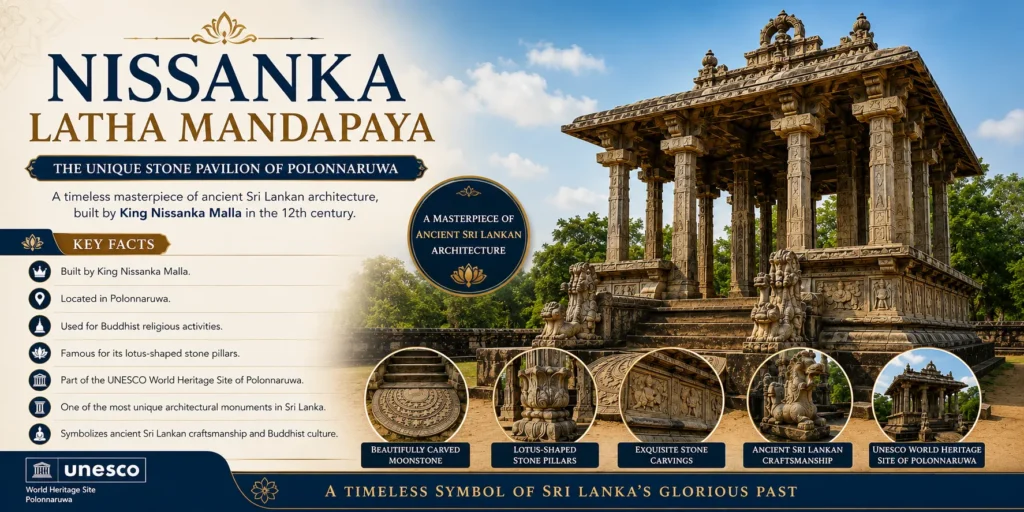
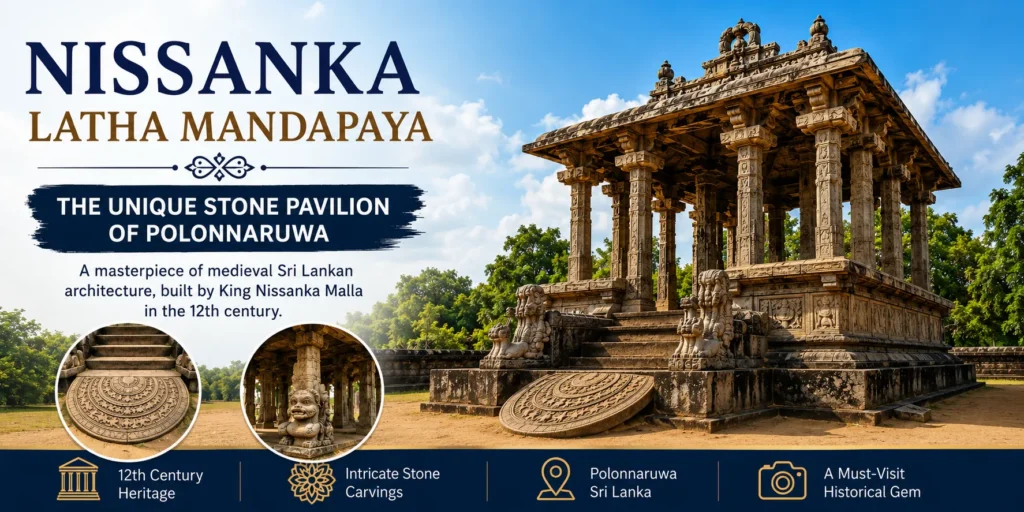
Nissanka Latha Mandapaya is one of the most fascinating historical monuments in Sri Lanka. Located in the ancient city of Polonnaruwa, this remarkable stone structure was built during the reign of King Nissanka Malla (1187–1196 AD). It is considered one of the most unique architectural creations in the country because of its beautifully carved stone pillars that resemble lotus stems.
Today, Nissanka Latha Mandapaya is one of the most visited attractions in the Polonnaruwa Archaeological Site and stands as a symbol of the artistic and engineering skills of ancient Sri Lankan craftsmen.
History of Nissanka Latha Mandapaya
King Nissanka Malla was one of the notable rulers of the Polonnaruwa Kingdom. He was known for his devotion to Buddhism and his efforts to develop religious monuments across the kingdom.
The Nissanka Latha Mandapaya was built as a place where Buddhist monks and devotees could gather for religious activities. Historical records suggest that the king used this pavilion to listen to the recitation of Buddhist scriptures. It was designed specifically for religious ceremonies and meditation.
The structure was constructed near important religious buildings in Polonnaruwa, showing its significance in the spiritual life of the kingdom.
Unique Architecture
The most striking feature of the Nissanka Latha Mandapaya is its extraordinary stone pillars. Unlike ordinary pillars found in other ancient buildings, these pillars curve gracefully inward at the top, resembling lotus flower stalks.
Each pillar is carefully carved from stone and demonstrates the exceptional craftsmanship of ancient Sri Lankan builders. The pillars support a stone roof structure, although much of the original roof has not survived.
At the center of the pavilion is a raised stone platform. Historians believe this platform may have been used for placing sacred texts or for important religious ceremonies.
The entire structure is surrounded by intricately carved stone railings and decorative elements, adding to its beauty and uniqueness.
Importance in Buddhism
Nissanka Latha Mandapaya played an important role in Buddhist religious activities during the Polonnaruwa period. It served as a gathering place for monks and worshippers who came to listen to Buddhist teachings and participate in religious events.
King Nissanka Malla was a strong supporter of Buddhism and sponsored many religious projects throughout the kingdom. The construction of this pavilion reflects his dedication to preserving and promoting Buddhist traditions.
The monument remains an important symbol of Sri Lanka’s Buddhist heritage and cultural identity.
Engineering and Artistic Achievement
The design of Nissanka Latha Mandapaya demonstrates the advanced engineering knowledge of ancient Sri Lanka. Creating curved stone pillars with precise symmetry required remarkable skill and planning.
The lotus-inspired design reflects the importance of the lotus flower in Buddhist symbolism. In Buddhism, the lotus represents purity, enlightenment, and spiritual growth.
The combination of religious symbolism and architectural excellence makes Nissanka Latha Mandapaya one of the most distinctive monuments in South Asia.
Nissanka Latha Mandapaya Today
Today, Nissanka Latha Mandapaya is preserved as part of the Ancient City of Polonnaruwa, a UNESCO World Heritage Site. Thousands of local and international visitors travel to Polonnaruwa each year to admire this architectural masterpiece.
The monument provides valuable insights into the culture, religion, and engineering achievements of medieval Sri Lanka. Archaeologists and historians continue to study the site to learn more about the Polonnaruwa Kingdom.
Visitors are often amazed by the elegant stone pillars, which remain one of the finest examples of ancient Sri Lankan stone craftsmanship.
Conclusion
Nissanka Latha Mandapaya is one of Sri Lanka’s most unique historical monuments. Built by King Nissanka Malla, this beautiful stone pavilion showcases the artistic talent, engineering expertise, and religious devotion of the Polonnaruwa era.
Its distinctive lotus-shaped pillars make it unlike any other structure in Sri Lanka. Today, it continues to inspire visitors and serves as a proud reminder of the country’s rich cultural and architectural heritage.