
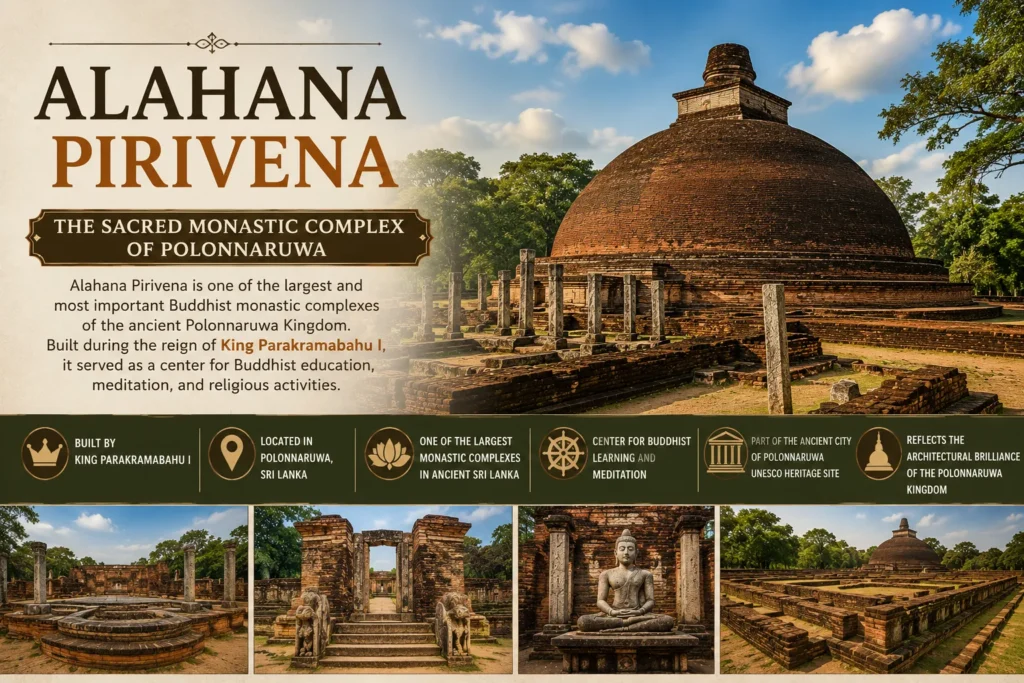
Alahana Pirivena is one of the largest and most important monastic complexes in ancient Sri Lanka. Located in the historic city of Polonnaruwa, this remarkable archaeological site represents the religious, educational, and cultural achievements of the Polonnaruwa Kingdom. Built during the 12th century, Alahana Pirivena served as a major center for Buddhist learning and monastic life.
The complex contains several important structures, including temples, stupas, image houses, chapter houses, and residential quarters for monks. Among its most famous monuments are the Lankatilaka Image House, Kiri Vehera, Tivanka Image House, and the Thuparamaya Gedige. These structures continue to attract thousands of visitors every year and provide valuable insights into the rich Buddhist heritage of Sri Lanka.
Today, Alahana Pirivena remains one of the most significant archaeological attractions in Polonnaruwa and forms part of the UNESCO World Heritage Site of the Ancient City of Polonnaruwa.
History of Alahana Pirivena
Alahana Pirivena was established during the reign of King Parakramabahu I (1153–1186 AD), one of the greatest rulers in Sri Lankan history. King Parakramabahu was a strong supporter of Buddhism and worked extensively to unify the Buddhist monastic order throughout the country.
The king recognized the importance of education and religious training for Buddhist monks. As a result, he developed Alahana Pirivena into a major monastic university where monks could study Buddhist scriptures, philosophy, literature, and religious practices.
The word “Pirivena” refers to a monastic educational institution where Buddhist monks receive training and education. Alahana Pirivena became one of the leading centers of Buddhist learning in medieval Sri Lanka and played a significant role in preserving Buddhist teachings.
Architectural Excellence
Alahana Pirivena showcases the advanced architectural and engineering skills of ancient Sri Lankan builders. The entire complex was carefully planned and constructed to serve both religious and educational purposes.
The buildings were constructed using stone, brick, and plaster, demonstrating the high level of craftsmanship achieved during the Polonnaruwa period. The layout of the complex reflects the organized nature of monastic life and provides separate areas for worship, study, meditation, and residence.
Many of the structures feature beautifully carved stone decorations, intricate sculptures, and impressive brickwork that continue to amaze visitors today.
Lankatilaka Image House
One of the most famous structures within Alahana Pirivena is the Lankatilaka Image House. This massive brick building was constructed to house a gigantic standing Buddha statue.
Although the upper portion of the statue has been damaged over time, the remaining structure still demonstrates the grandeur of ancient Sri Lankan architecture. The towering walls and detailed carvings make Lankatilaka one of the most photographed monuments in Polonnaruwa.
The image house reflects the deep devotion of the Polonnaruwa kings to Buddhism and their commitment to constructing magnificent religious monuments.
Kiri Vehera
Another important monument within Alahana Pirivena is Kiri Vehera, one of the best-preserved stupas in Sri Lanka. The stupa is believed to have been built by Queen Subhadra, the wife of King Parakramabahu I.
Kiri Vehera remains largely intact and retains much of its original appearance. The bright white structure stands as a symbol of Buddhist faith and attracts both pilgrims and tourists.
The stupa served as an important place of worship and remains one of the most sacred sites in the Polonnaruwa Archaeological Park.
Importance in Buddhist Education
Alahana Pirivena was not only a religious center but also an educational institution. Buddhist monks living within the complex received training in religious studies, meditation, discipline, and scholarship.
The monastery helped preserve Buddhist literature and traditions during a period when Sri Lanka was one of the leading centers of Buddhist learning in Asia. Scholars and monks from different regions visited the monastery to study and exchange knowledge.
This educational role made Alahana Pirivena an important contributor to the development of Sri Lankan culture and Buddhist civilization.
Religious and Cultural Significance
Alahana Pirivena played a central role in the spiritual life of the Polonnaruwa Kingdom. Religious ceremonies, teachings, meditation programs, and community gatherings were regularly held within the complex.
The monastery symbolized the close relationship between the royal administration and the Buddhist clergy. Kings supported the monastery through donations and construction projects, while monks provided religious guidance and education to society.
Today, the site continues to represent the enduring influence of Buddhism on Sri Lankan culture and national identity.
Alahana Pirivena Today
Today, Alahana Pirivena is one of the most visited historical sites in Sri Lanka. Archaeologists continue to study the complex to better understand the religious and educational systems of medieval Sri Lanka.
Visitors can explore the ruins, admire the ancient architecture, and learn about the important role the monastery played in the history of the island. The preservation of the site helps future generations appreciate Sri Lanka’s rich cultural and religious heritage.
The monuments within Alahana Pirivena remain outstanding examples of ancient Sri Lankan architecture and Buddhist civilization.
Conclusion
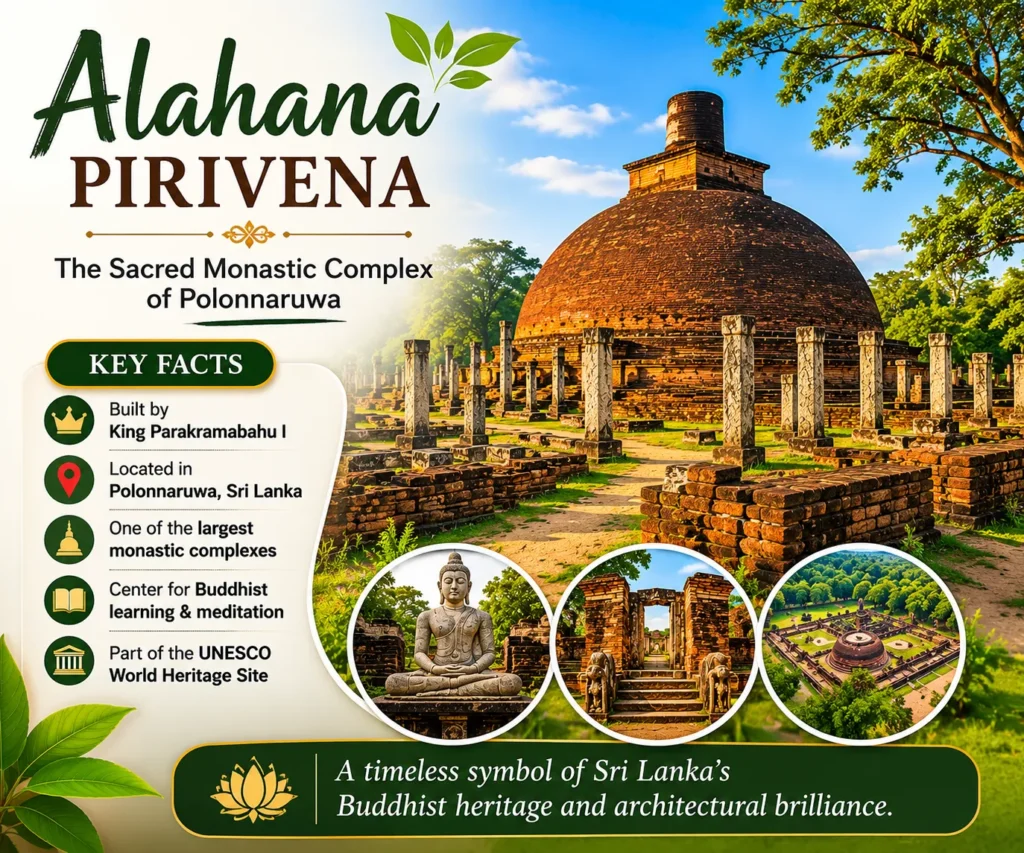
Alahana Pirivena stands as one of the greatest achievements of the Polonnaruwa Kingdom. Built as a center for Buddhist education, worship, and monastic life, the complex reflects the religious devotion, architectural excellence, and cultural richness of medieval Sri Lanka.
From the magnificent Lankatilaka Image House to the sacred Kiri Vehera, every structure within the complex tells a story of faith, knowledge, and artistic brilliance. Today, Alahana Pirivena continues to inspire visitors from around the world and remains a proud symbol of Sri Lanka’s extraordinary Buddhist heritage.